Tuesday, 20 December 2016

TOGO


Togo is a small West-African country lying between Benin and Ghana. It is a long and narrow strip with a small coastline. Grassy plains and hills are the general landscape. The climate is hot and rainy. In the west it has a rainfalls of 90 cm a year.


The Togo hills rise in the centre of the country and are the border between Togo and  Ghana. On the eastern side Togo borders on Benin and in the north on
Burkina Faso

TOGO TOURIST ATTRACTION


Agriculture
Most of the people are farmers although the land is fairly poor. The main crops are palm kernels and coconuts in the south. Coffee and cocoa are grown in the hills. Peanuts, millet and cotton in the north.
Togo produces a lot of phosphate rock which is used as fertilisers.


Religion
In the north are mostly Muslims who dress in flowing white robes. In the south Christianity is widely spread and they wear usually Western clothes.

A traditional drummer parades through the street of Lome. Most people in Togo follow animist religions based on local gods and spirits.


History
Germany ruled Togo before the World War I, When it was taken over by Britain and France. The British part named Togoland joined with Ghana in 1957.

The French part went its own way and became independent in 1960.


The Togo Republic has a population of 3,8 million and an area of 56,785 sq km. The capital is Lome.


TOGO'S CAPITAL LOME

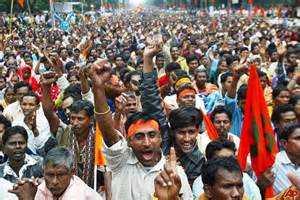
Gnassingbe Eyadema has ruled Togo since 1967 but his power is declining since democracy is in demand. He was forced to hold an elections in 1993 and had to appoint an opposition prime minister in 1994.


Monday, 19 December 2016

IVORY COAST


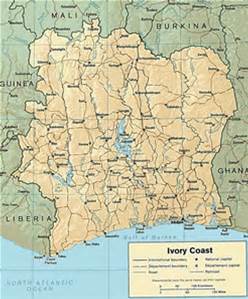
The Ivory Coast was a colony of France. The country official name is Cote
d'Ivoire. It is one of the most prosperous West Africa countries.

The landscape copies Ghana with rain forest in the south and high grassy plains in the north.


The hot, steamy south was covered with forest but it was cut down to make way for coffee and cocoa plantations.


Many wild animals live on the northern plateau such as lions, monkeys, antelopes and elephants. There is also grazing for cattle.


Two-thirds of the people living there are growing food like maize, rice and jams. Crops for export are grown and Ivory Coast is one of the world's largest coffee and cocoa producers.


Industry
Younger generation are working in factories in the old capital and chief port,
Aidjan. Half of the population is under 20 years old. Flour mills food canneries, breweries, sawmills, textile and plastics manufacturers are all thriving.

Since 1980 there is a prosperity boost from an offshore oil extracted from the Gulf of Guinea.


History

From 1893 to 1960 the French ruled the country. It became independent under the presidency of Felix
Houphouet-Boigny. He remained till his death in December 1993.

His policies were  - keep close ties with France; allowing plenty of foreign investment and keeping tribal rivalries under control.


ABIDJAN

 One of his major acts were to move the capital from Abidjan, known as the Paris of Africa, to his home village of Yamoussoukro.


YAMOUSSOUKRO CITY


The Ivory Coast republic has a population of 13 million and an area of 322,463 sq km. The religion is Muslim, Christian and Traditional.


 BASILICA OF OUR LADY OF PEACE

A Basilica of Our Lady of Peace was built in the capital and it is the  biggest church in the world. It is modelled on St Peter in Rome and completed in 1989.

Saturday, 26 November 2016

YEMEN


On the tip of the Arabian peninsula. Yemen is a large country. It is just smaller than France but two-thirds of it is uninhabited.


Yemen borders in the west by the Red Sea; on the north by Saudi Arabia; on the East by Oman and on the south by the Gulf of Aden.


In the west lies a wide coastal strip the
Tihama along a range of mountains. The highest peak Jaban an-Nabi Shu'ayh is 3700m. Behind the mountains lies a fertile high plateaux. In the middle of it is the capital San'a at an altitude of 2250m.

In these highlands are active volcanoes with hot springs and some times earthquakes.


The lower mountains towards Oman, in the east, are only 1000m high.


In the north the southern end of the Arabian Desert riches into Yemen till the middle of it.


AGRICULTURE
Yemen has twice a year a monsoon coming from the south. It make the country the most arable spot on the Arabian peninsula. The temperature various between regions and seasons.

Tihama and the southern coast are hot and with high humidity and a daytime temperatures topping 40C in summer.

Yemen cultivated so much land that little natural vegetation remain. In Tihama there are mangroves, salt-resistant plants pm the seashore and sparse grasses and shrubs on the dune valleys.

Inland, around the wadis and in the mountain foothills, the land is moist enough for evergreen plants growing, including palms and acacias.


Hunting had killed off most of the wild animals. There were leopards, gazelles, hyenas and jackals in southern Yemen.


TRIBAL LIFE
Yemen is a tribal society and the tribes are joined in 'federation'. Most people live in houses built of natural material. on the plains and around wadis, building materials are mud, brick and reeds.

Mountain houses are mostly build with stones.

RELIGION
The state religion is Islam while in the south are mostly Sunni Muslims and in the north are Shi'a sect. There was a minority of Jews but when the Israel was established in 1948 the majority left.

Yemen is a developing country with little industry. The majority is agriculture with most of the crops for its people.


Tropical fruit is grown on low level. At the middle level cereal is grown and at high level are coffee and
qat grown to export. On the central highlands sorghum , vegetables and spices are grown.


OIL ECONOMY
Oil was discovered in Marib in late 1980 but the output is low. The Yemen economy was mainly supported by its people working in oil-rich Gulf states.

In October 1990, Saudi
Arabia expelled over 1 million Yemenis because the country would support during the Gulf war. Most Arab countries and USA stopped economic aid and co-operation which a devastating impact.

HISTORY
Yemen used to be split into North and South Yemen. The North was ruled by an Imam, a religious leader, but was overthrown by a revolution.  Civil war continued until the 1970 when religious leaders agreed to a republican government run by the military. The country was renamed the Yemen Arab Republic (YAR).

Both north and south Yemen wanted to be reunited but the official relations between were bad.
In 1980, The
PDRY soften on its hard-line Marxist beliefs and better relation ship with YAR followed.

In 1990 unification was declared. The first free election  in the whole Arabian peninsula were held in April 1993 and a coalition government was formed between the three major parties.


YEMEN'S CAPITAL SAN'A

Friday, 11 November 2016

INDIA PART TWO


RESOURCES AND INDUSTRY
India is rich in minerals, with large deposits of coal, iron ore, oil, bauxite and zinc. The mining industry has progressed during the last decades but India is still not making full use of its huge mineral resources.

India has still rich tradition of crafts.

Manufacturing has increased since it started a series of a five-year economy development plans in 1951. Factories produce now cars, sewing machines, aircraft, textiles, railway engines and ships. The biggest bicycle factory in the world is Hero Cycles of Punjab.

India has the world's largest film industry much bigger than Hollywood. It has the nickname Bollywood because it was started in Bombay (Mumbay). It produces 700 films a year in 16 languages.

India is an independent federal republic and the largest democracy in the world. It is divided into 25 states and seven union territories. Each state has his own elected assembly and government.

The president of the republic heads the national government in New Delhi but is mainly a figurehead. Decision and the law is made in the lower house (Lok Sabha). The prime minister is usual the leader of the main party.

SUCCESSION OF EMPIRES
Ashoka in 3rd century BC united India but the Empire blossomed during the 4th century AD with Gupta.

PALACE IN JAIPUR

JODHPUR  PALACE

Then the Muslim empire followed and reached its height under Mughal emperors such as Akbar and Shah Jahan.


When the Mughal power declined Europeans went in and establish the East India Company in 1857. Revolt broke out and the British Government took over.


BOMBAY GATEWAY
WHERE BRITISH ALWAYS LANDED


It started the independent movement and under Mahatma Gandhi rapidly increased until 1947 India became independent. After Gandhi was assassinated Pakistan and Bangladesh split away.

Ever since India has dramatically improved economically and politically. India and Pakistan had also several wars.

ELECTIONS
Elections involves huge numbers of voters, voting stations and parties. In view of over 900 millions people living in India it is not surprising.

In 1991 there were over 314million people voting in the General Election; 359 parties to vote for; 565,000 polling station were needed and manned  by three million staff. 

INDIA PART ONE


India is the largest democracy. The country has great contrasts. It has nuclear power and satellite communications network yet most of the people's lives has not change  for century.

India is the seventh largest country by area. and only China has more than its 900 million people.

Its shape is a giant triangle jutting out into the Indian Ocean. Across the north are the Himalayas with some of the highest peak in the world. At the south of the Himalayas spreads across the country a broad and fertile land.

From Kashmir to the most southern tip, the cape Comoran, it is nearly 3000km.

There are many great rivers like the Ganges, the Brahmaputra, and several tributaries such as the Indus, flow across the northern plain and add to India's most fertile land.

A huge plateau in the south called the Deccan runs from the Arabian Gulf to the Bay of Bengal.

CLIMATE
Mountain areas in the north have a cool climate in summer and freezing temperatures in winter. The rest of northern India is very hot in summer. Temperatures can rich 48oC (120oF). The heat during the day is so intense people die of sunstroke. It last until the monsoon or the rainy season arrives.
Monsoons start on the cost in June and spreads across the north in July and August. In some parts this follows by a mild winter. but in the north. In Punjab and Bihar it can fall to freezing at night. The south and east has a humid climate for most of the year.

The Shillong plateau, just north of Bangladesh, is the second rainiest place in the world with 1.143cm (450 inches) a year. It is an important tea growing region.

LANGUAGES AND RELIGIONS
India has officially 16 languages and hundreds of locally spoken ones and over thousand dialects.

Children speak one language at home and become fluent in several more at school.

Hindi is the national language but many people in the south do not like to use it. English is often used at an official level.

The majority of Indians follow Hinduism. It is an ancient religion introduced by the Aryans nearly 3500 years ago. The river Ganges is sacred to Hindus, and many bathe in its waters at Varanasi.
There are also large numbers of Muslims, Christians, Sikhs, Jains and Buddhist.

The majority of Indians live in villages and most of them are very poor. They mostly work on the land but villages have a carpenter, shopkeeper and potter.

Wheat is the main crop in the northern plains while rice is mostly grown in the south. As well as rice, wheat. maize, millet and many other vegetables are grown there. India is one of the world largest producers of bananas, groundnuts, lentils, sugar cane, pepper, tea, coffee and cotton and jute for textiles.

India has the fourth largest railway network in the world with 62,000km of track. In some places it is still the only reliable transport since the roads are badly maintained. Most of the passenger trains are diesel and some electric.

There are still a great number of steam engines used and a joy to see for railway enthusiasts. They still run a incredible number of steam engines and all in immaculate conditions. Another remarkable point; they arrive dead on time even they have been travelling for 24 or even 48 hours. India has three class system. To travel in the first class is an absolute, enjoyable and affordable luxury.


It is incredible to us but it is India and its complete different way of live.


Thursday, 13 October 2016

AUSTRIAN SKI RESORT NEWS


The famous Austrian ski resorts Lech, Zuerch, Stuben and St Anton open their on-piste link this December.

It will make the Arlberg one of the biggest ski resorts in world. There are an unbelievable 82 lifts and 305km of pistes. It also promises no  queues.


ST ANTON AM ARLBERG

ST ANTON

Ski lifts are getting bigger, longer, faster and more comfortable.

The improvement of the ski resorts adds more hotels, chalets to be open in Decembers with a wide variety of styles.


LECH AUSTRIA

 If you would like to have a good time on a reasonable low budget book private  but book early because they are quickly taken.  You will get beautiful rooms with showers, a family, friendly service including a rich  breakfast. 

British Airways now flies from Heathrow direct to Innsbruck at a low price.


Tuesday, 11 October 2016

SALZBURG CHRISTMAS MARKET


Salzburg, Austria, is very well known through Wolfgang Mozart who lived and composed there. The house where he lived is in the main street and can be seen.

But
Salzburg has also another attraction; its many Christmas Markets. The main Christ mas Market is in the Cathedral Square with the romantic background setting adding to it.
================================================
PLEASE BE SO KIND AND CLICK ON ADVERTS. THANK YOU
================================================

The stalls sell mullet wine, ginger bread biscuit, roast sausages over coal fired grills, all sorts of decoration and with the snow it leaves nothing out of Christmas.


The aromas out beat one another. Choirs and musicians  are on every corner and adding even more to the atmosphere.


In Austria the
Christkind appears and brings present. It is a big golden angel flying down from the sky down to earth. The Christkind will come to the market on Saturdays between 3,30 and 6,30 pm and entertain the children.

Santa Claus or St Nikolaus comes on the 6 December and brings small presents if you were good.
Snowboarders and skiers are not left out because behind
Salzburg are any amount of ski-runs for various abilities and snowboarders.

On the other side of the river
Salzach is Mirabell Palace and on the Mirabellplatz is another Christmas Market with all the festivities in the stalls for your pleasure and entertainment.

On the mountains overlooking
Salzburg is a castle Hohensalzburg Fortress displaying another Christmas Market in the big courtyard with homemade articles. It differs with medieval entertainments and brass bands.

A wonderful views across the snow covered mountains add to your joy.